 Sandra Park
My dog Cleo has slept in the same 6-inch window of sunlight every morning for eight years, except now that window moves. Montana one week, New Mexico the next. She adjusted faster than I did.
I’ll be honest: I went into full-time RV life assuming pets would be the hard part. I’d read all the forums. Anxious dogs, motion sickness, campgrounds that don’t allow certain breeds, veterinary access in the middle of nowhere. The warnings stacked up. What surprised me was that most of the real challenges weren’t the ones people warned me about. The pet stuff that actually broke my rhythm was mundane and avoidable, and the pet stuff I dreaded mostly didn’t happen.
This is the real rundown. Not the “RVing with pets is magical!” content, not the fear-mongering either. Just what eight years with a 65-pound mixed breed and, later, a second dog and a cat have actually taught me.
Before You Even Hook Up the Tow Vehicle
The single biggest mistake I see new RVers make with pets is doing zero prep before the first long haul. They figure the animal will sort itself out. Sometimes that’s true. Often it isn’t.
Motion sickness is real. More common in dogs than most people admit. You might not see dramatic vomiting, though. Sometimes it’s just excessive drooling, lethargy, or a dog that refuses to eat for the entire travel day. Cleo had mild nausea for the first dozen trips before her inner ear adapted. My vet recommended Cerenia (maropitant citrate) for longer drives, which costs around $3-$5 a pill depending on the pharmacy. For a dog that’s genuinely miserable, that conversation’s worth having. Ginger supplements and holding food 4-6 hours before departure work for some dogs too, if you want to start lower-key.
Get your vet records in order before you go mobile. Actually do this. I can’t tell you how many times I’ve needed proof of rabies vaccination to get into a campground, board an animal in an emergency, or cross into Canada. A physical folder with printed records is decent. A PDF on your phone is better. I use a Google Drive folder now, shared with my partner, labeled by animal and year. Dead simple.
If your pet isn’t microchipped, get that done yesterday. A dog that bolts in an unfamiliar campground in a state you’ve never been to has almost no chance of finding you without one.
The Campground Reality (It’s Rougher Than the Websites Say)
Pet policies at campgrounds are inconsistent in ways that will genuinely frustrate you. Some KOAs are dog paradise. Some state parks have tight leash rules and zero designated off-leash areas. I’ve pulled into a spot after a nine-hour drive and discovered the campground had a 25-pound weight limit I somehow missed in the fine print.
Breed restrictions are especially annoying. Pit bulls, Rottweilers, Dobermans, and Huskies get flagged constantly, and whether your dog qualifies depends entirely on how the campground defines the breed and how the staff feels that day. If you have a dog that could be misidentified, get a DNA test (Embark runs about $99 during sales) just to have documentation on hand. It won’t work everywhere, but it’s worked for me twice when a manager wanted to argue about whether Cleo was “part pit.”
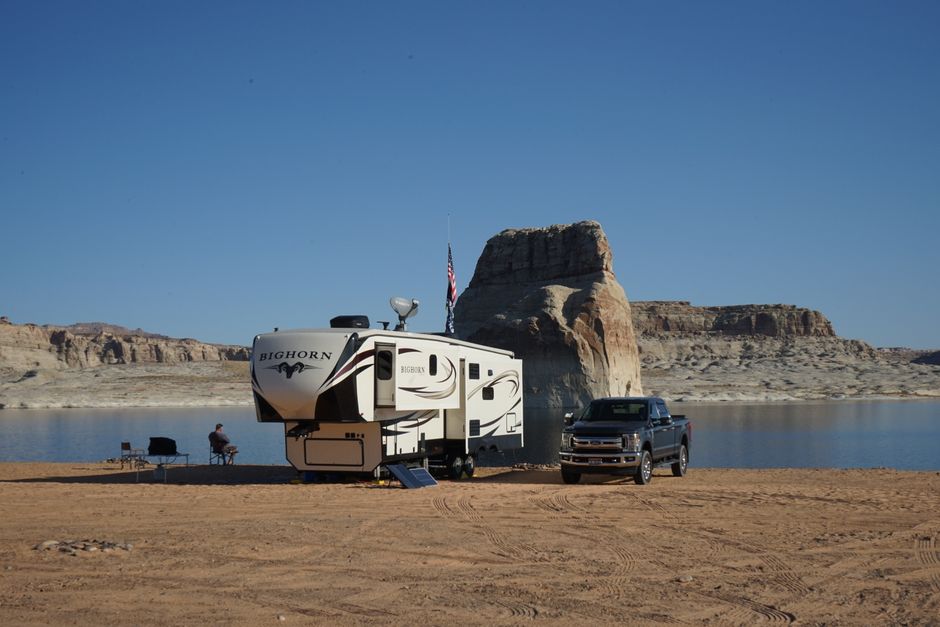
What nobody tells you: the nicest campgrounds for pets are often Army Corps of Engineer sites, national forest dispersed areas, and BLM land. Minimal fees, no breed discrimination, no gravel pad squeezed between two other rigs. The trade-off is that hookups are rare and you’ll need to be self-sufficient. That’s a whole other article, but the short version is: solar gets you farther than you’d think.
One more thing. Waste management. I know. But campgrounds that otherwise love dogs will absolutely enforce pick-up rules, and “I didn’t see it in the dark” is not a defense. I keep a roll of bags clipped to the door handle and a small bin with a lid inside for disposal before I find a dumpster. The Doggie Dooley waste disposal system is something some full-timers swear by for longer stays, though it requires a permanent install that doesn’t work for everyone.
Keeping Animals Safe While You’re Rolling
| Item | Cost | Notes |
|---|---|---|
| Cerenia (maropitant citrate) per pill | $3-$5 | For motion sickness on longer drives |
| Embark DNA test | ~$99 | Often cheaper during sales; helps with breed restriction disputes |
| Sleepypod Clickit Sport harness | ~$80 | Crash-tested by Center for Pet Safety |
| ThermoPro TP65S thermometer | ~$25 | Remote sensor; monitors RV interior temperature via phone |
This is where I’ll push back on the conventional wisdom. Most of what you see online says crate your dog every time you move. I understand the safety logic. A loose 65-pound dog becomes a projectile in a sudden stop. Hard to argue with physics.
But here’s the thing: not every dog tolerates crating, and not every RV layout accommodates a large crate in a way that’s actually safer than the alternative. What I do, and what I’ve landed on after years of testing, is a combination approach. Cleo rides in a crash-tested harness (I’ve used the Sleepypod Clickit Sport, which runs about $80, and it’s the only one that’s been tested in actual crash simulations by the Center for Pet Safety) clipped to the seatbelt. It’s not perfect, but it’s meaningfully better than nothing.
Cats are a different story entirely. Cats in cars are basically unsolvable. Every cat I’ve known either tolerates the carrier or actively loses its mind. My cat Jasper destroyed two soft carriers before I gave up and bought a hard-sided Petmate Sky Kennel. He hates it. He screams for approximately 45 minutes, then gives up and sleeps. We’ve reached an understanding.
Temperature is the other big one. RV interiors heat up catastrophically fast when you’re stopped and the AC is off. I have a cheap dual thermometer with a remote sensor that lets me check interior temp from my phone while I’m at a trailhead. The ThermoPro TP65S runs about $25 on Amazon and has saved me from real anxiety on warm-weather driving days. If you’re parked somewhere hot and need to run into a store, your propane refrigerator and a cracked vent won’t cut it. Either run the generator with AC on, find a dog-friendly spot to take them, or don’t stop.
Veterinary Access on the Road
This was the thing I most underestimated, and I’ve watched it stress out more full-timers than any other pet issue.
Most vets won’t take you as a walk-in for non-emergencies. You need to be an established patient, or you need to book out weeks ahead, or you need to pay the out-of-hours emergency clinic rate, which runs $100-$200 just to walk in the door before any treatment. When Cleo tore a nail on a rocky trail outside Moab, Utah, the nearest emergency vet was 45 minutes away in Grand Junction, Colorado, and the total bill was $340 for what amounts to a ten-minute procedure at a regular vet.
What actually helps: the Banfield Pet Hospital partnership program gives you access to any Banfield location (they’re inside PetSmart locations across the country) with your existing records. Not perfect, but usable. Vetco clinics at Petco do low-cost vaccines on a drop-in basis. Telehealth has become genuinely useful for “is this an emergency or can it wait” triage. I’ve used Dutch and Pawp for that, and they’re worth the subscription cost if you’re remote regularly.
Pet insurance deserves a real conversation before you go full-time. The research here is mixed on whether it saves money in aggregate, but for mobile life where emergency vet bills can’t be predicted or spread across a familiar network, the peace of mind has real value. I’ve used Trupanion and Healthy Paws. Both had frustrating claim processes. Neither was a scam. That seems to be about as good as it gets right now.
The Daily Rhythm That Actually Works
Sources
- Doggie Dooley waste disposal system
- Helena Lopes
- part pit. What
- here is mixed on whether it saves money in aggregate
The thing that took me longest to figure out wasn’t a gear problem or a logistics problem. It was understanding that my pets needed a routine even when geography was completely fluid.
Dogs especially. They don’t care that you’re parked in a new state. They care whether they went on a walk this morning and whether someone is acting weird (you), and whether that thing outside the window smells threatening. Keeping feeding times, walk times, and bedtime rituals consistent across wildly different environments dramatically reduces anxious behavior. It sounds obvious but I still see people wondering why their dog is barking all night in a new campground when they’ve completely abandoned the cues the dog has always used to understand what day it is.
Cats adjust slower and hate change more, but the same principle applies. Jasper’s food goes in the same corner of the rig no matter where we park. His litter box is in the same spot. His blanket is the same blanket. He still complains for the first two days somewhere new. Then he finds a sunny patch and completely stops caring.
The other thing: exercise. If your dog is getting real exercise every day, probably 75% of behavioral issues on the road just don’t happen. A tired dog doesn’t bark at the neighbor’s generator. I try to find a trail or a field every single day we’re stationary, even if it’s just 20 minutes. On driving days, extra walk breaks at rest stops. It’s not complicated. It’s just the part people skip when they’re tired from driving.
Eight years in, Cleo knows the sound of the slideout retracting means we’re moving. She goes and finds her spot on the bench seat. Jasper starts yelling. The other dog, Finn, who joined us three years ago and has never known anything but this life, just looks confused about what everyone’s upset about.
That’s probably the most honest endorsement I can give you. The animals who grow up in this life don’t think it’s hard. They think it’s just life. The adjustment is yours to make, not theirs.
Photo: Helena Lopes via Pexels