 Barbara Mitchell
Most people think upgrading from 30 amp to 50 amp service is just “more power, problem solved.” I believed that too, until I blew a pedestal breaker at a campground in the Texas Hill Country because I didn’t understand what was actually happening inside those two very different electrical systems. Here’s what I wish someone had explained before I spent three summers just plugging in and hoping.
30 Amp vs. 50 Amp: They’re Not Just Different Sizes of the Same Thing
| Specification | 30 Amp Service | 50 Amp Service |
|---|---|---|
| Voltage Configuration | Single 120-volt leg | Two separate 120-volt legs |
| Hot Wires | 1 | 2 |
| Plug Prongs | 3 | 4 |
| Maximum Amperage | 30 amps | 50 amps per leg |
| Total Wattage Available | 3,600 watts | 12,000 watts |
| Typical RV Type | Small travel trailers, Class C | Large fifth wheels, Class A |
| AC Unit Capacity | 1 unit comfortable | 2+ units feasible |
This is where most guides lose people by framing it as “30 amp = smaller rigs, 50 amp = bigger rigs” and moving on. The real story matters more.
A 30 amp service runs on a single 120-volt leg. One hot wire, one neutral, one ground. Your maximum power draw is 30 amps times 120 volts, which gives you 3,600 watts total. That’s everything: air conditioner, microwave, water heater, charging devices, the fridge if it’s running on electric. All of it, simultaneously, cannot exceed 3,600 watts.
A 50 amp service is completely different. It runs two separate 120-volt legs, each capable of 50 amps. So you’re looking at 50 amps times 120 volts times 2 legs equals 12,000 watts of available power. More than triple the capacity.
What surprised me was the physical difference. The 50 amp plug has four prongs: two hots, one neutral, one ground. The 30 amp plug has three. They work differently. The campground pedestal treats them very differently. This isn’t just a bigger fuse in the same circuit.
What Your Rig Actually Needs (And How to Figure It Out)
Before you worry about the campground hookup, check your rig’s electrical panel sticker. It’ll say either 30 amp or 50 amp. That’s not a preference, it’s a hard spec.
Think about your real-world load. Add up what you’d run simultaneously:
- A single roof AC unit: roughly 1,200 to 1,500 watts running (more on startup)
- Microwave: 1,000 to 1,500 watts
- Electric water heater: 1,200 watts
- Residential refrigerator: 150 to 400 watts
- Converter/charger: 500 to 1,500 watts
A 28-foot travel trailer with one AC and a standard microwave stays comfortable on 30 amp if you’re thoughtful. A 40-foot fifth wheel with two ACs and a residential fridge will be miserable on 30 amp because you’re tripping breakers constantly or running a load management system that cycles appliances off automatically.
I ran a 30 amp Class C for three years before moving to a 50 amp fifth wheel. The discipline required to manage loads taught me more about my electrical system than anything else. You learn fast when the breaker trips in July in Phoenix.
Adapters: The Right Way and the Wrong Way to Use Them
Adapters are everywhere in the RV world, and this is where dangerous habits start.
A 50-to-30 amp adapter (sometimes called a “dog bone”) lets your 50 amp rig plug into a 30 amp pedestal. It works, with a big caveat: you’re now limited to 30 amp service (3,600 watts), but your rig doesn’t know that. You have to manually manage your load. Run both ACs at once and you’ll trip the pedestal breaker. Repeatedly tripping campground pedestals damages the breaker over time and gets you that reputation.
A 30-to-50 amp adapter goes the other direction: it lets a 30 amp rig use a 50 amp pedestal. This one is fine because you’re not drawing more than your rig can handle. No risk.
Never use adapters with a damaged cord, run them in standing water, or daisy-chain multiple adapters together. I’ve seen people stack two adapters to bridge odd connector combinations. Don’t.
A quality surge protector rated for your amperage should be mandatory regardless of which service you’re using. Campground pedestals can have miswired outlets, voltage problems, and power surges that fry your converter, inverter, or residential appliances. I’ve run a Progressive Industries EMS on every rig I’ve owned. It caught problems at three different campgrounds that would’ve cost hundreds in repairs. (This site may earn a commission on qualifying purchases.)
Step-by-Step: Connecting Safely at Any Campground
This is the routine I use every single time, without shortcuts. Eight years in, I still do all of this.
1. Check the pedestal before you touch it. Look for scorch marks, damaged outlets, loose covers, standing water, or corroded contacts. If anything looks wrong, ask the campground to fix it or move sites. This takes 30 seconds and has saved me twice.
2. Turn off the pedestal breaker before plugging in. Some people skip this. I don’t. Plugging a live cord into a live outlet under load causes arcing, which damages contacts over time.
3. Connect your surge protector to the pedestal first. Let it test the outlet. A good EMS unit will show you voltage on both legs (for 50 amp) and flag open ground, open neutral, or reverse polarity before your rig is even connected. Wait for the green light or the all-clear delay, usually 120 seconds on power-up.
4. Connect your power cord to the surge protector. Make sure the connection is fully seated. Partially seated connections cause heat and resistance, which causes fires.
5. Turn on the pedestal breaker. Now power flows to your rig.
6. Check your voltage inside the rig. If you have a battery monitor or panel display, glance at it. Anything below 105 volts or above 130 volts is a problem. Low voltage is particularly hard on AC compressors and motor-driven appliances.
7. At disconnect, reverse the order. Turn off the pedestal breaker, unplug your cord, then unplug the surge protector.
Voltage, Amperage, and Why Campground Power is Often Terrible
The power quality at many campgrounds is genuinely bad, and this doesn’t get talked about enough. During summer peak hours, when half the park runs their ACs simultaneously, voltage can sag to 105 or even lower. This is called “low voltage” or a “brownout,” and it’s brutal on your equipment.
Here’s what happens physically: when voltage drops, your appliances draw more amperage to try to maintain the same power output. Your AC compressor works harder. Your converter runs hotter. Everything runs less efficiently. Over time, this degrades equipment life, particularly compressors, which are expensive.
A 50 amp surge protector with EMS that includes voltage protection will disconnect your rig automatically when voltage falls outside a safe range. Worth every penny. (This site may earn a commission on qualifying purchases.)
Most manufacturers rate appliances for 110-120V nominal operation, and consistent operation below 108V is generally considered risky for compressor-based equipment. I treat anything below 108V as “shut off the ACs and call the camp host.”
Boondocking, Solar, and the 30/50 Amp Conversation
Sources
If you’re spending significant time off-grid, the 30 vs. 50 amp question shifts entirely. You’re not plugging into a pedestal, so shore power capacity matters less than your battery bank, solar input, and inverter capacity.
What does matter off-grid is understanding your rig’s 12-volt DC system versus its 120-volt AC system. Most RVs run lights, fans, and the furnace blower on 12V DC. Your ACs, microwave, and residential fridge run on 120V AC, which off-grid means you need an inverter pulling from your batteries.
A quality battery monitor becomes essential because you’re managing a finite resource, not a continuous supply. I run a Victron BMV-712 and check it compulsively when boondocking. (This site may earn a commission on qualifying purchases.)
Solar panels can offset daytime consumption significantly, but if you’re running a 50 amp rig with two ACs off solar and batteries, you’re talking about a serious system: 800+ watts of panels, a large lithium battery bank, and a 3,000-watt or larger inverter. That’s $5,000 to $15,000 depending on your specs. The 30 or 50 amp label on your shore power connection tells you almost nothing about its off-grid capability. Those are separate systems entirely.
The honest version is that neither 30 amp nor 50 amp service is inherently better. It’s about matching your rig’s requirements to what’s available and knowing what to do when they don’t match. After years of blowing pedestal breakers, chasing voltage problems, and getting comfortable with adapters, what sticks with me is this: the campground electrical system is not your friend by default. It’s an unknown you have to verify every single time. Build the habit, use the protection, and you’ll sidestep most of the ugly surprises.
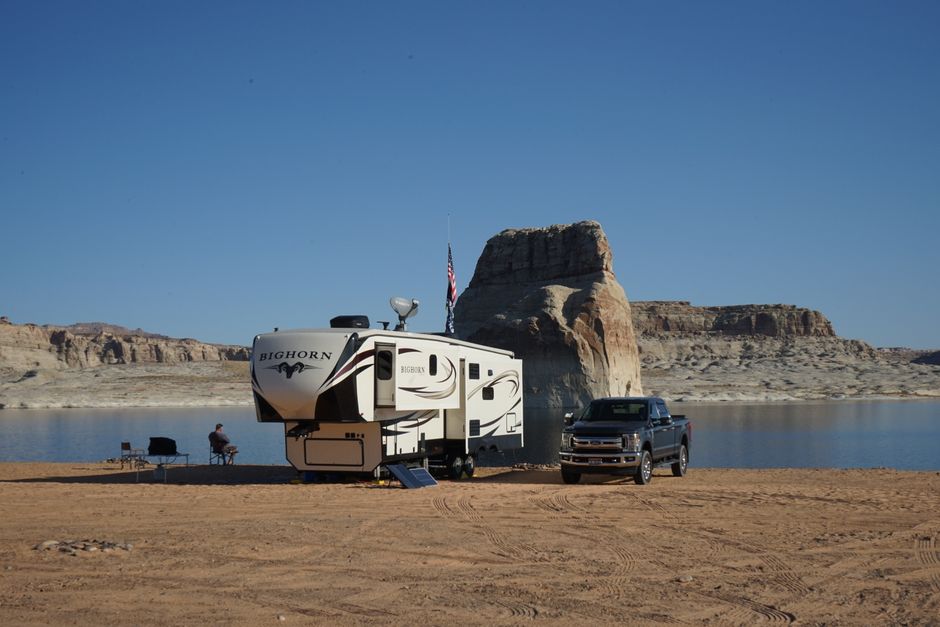
Photo: zvika shmaya via Pexels