 Julia Davidson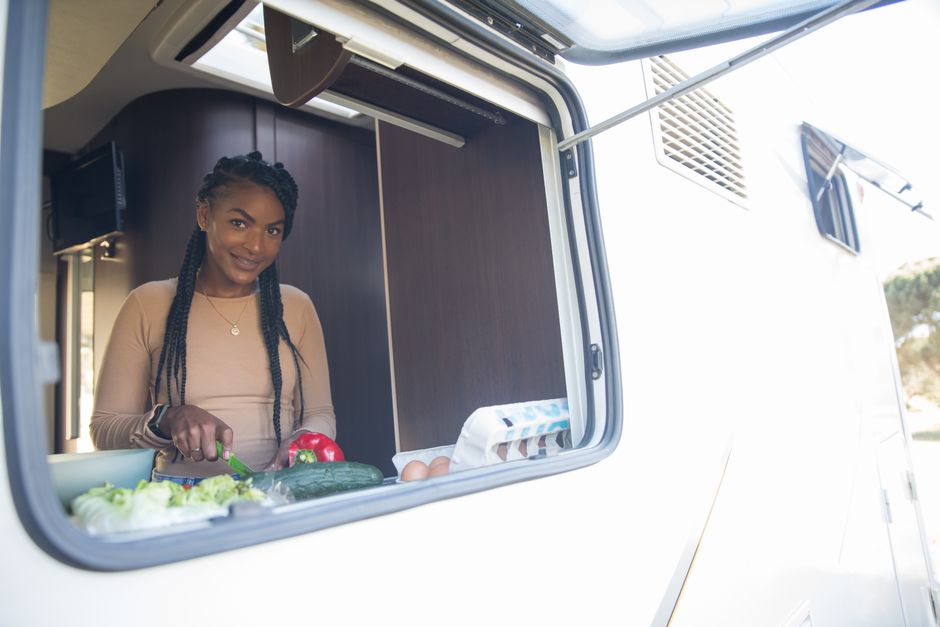
The first meal I cooked in my rig was a disaster. A full pot of pasta water sloshed off a two-burner propane cooktop somewhere outside Flagstaff, I had no colander that fit my one deep bowl, and the cutting board slid off the counter every time I touched it. I ate gas station chips that night. That was eight years ago, and I’ve cooked somewhere between 5,000 and 6,000 meals in small RV kitchens since then. The learning curve is real, but it’s shorter than you think.
You might be wondering whether RV cooking is really that different from apartment cooking. Honestly? Yes and no. The techniques are the same. The constraints are completely different. Counter space is measured in inches, not feet. Propane tanks run out at inconvenient times. Your pantry is also your cabinet space, your storage, and sometimes your road-trip luggage zone. And if you’re boondocking three days from the nearest Walmart, “I’ll just run to the store” isn’t an option. So you plan differently, stock differently, and cook differently. That’s what this is about.
The Pantry System That Actually Works in a Small Space
Most people coming from a house try to replicate a house pantry. Wrong approach. You’re not stocking a kitchen. You’re stocking a galley, which is closer to a boat than a home.
Here’s what I tell people who are just starting out: build your pantry around a meal matrix, not a shopping list. Pick 8 to 12 base meals you genuinely like and know how to cook. Figure out the ingredient overlap between them. Then stock for those meals, in rotation.
My current matrix includes: shakshuka, black bean tacos, pasta with olive oil and garlic (or canned tuna if I’ve got it), fried rice, grain bowls, lentil soup, quesadillas, and a rotating “use what I have” stir-fry. Notice that eggs, canned tomatoes, canned beans, garlic, olive oil, rice, and some kind of grain appear in almost every single one. That overlap is the point. You’re not buying 12 sets of ingredients. You’re buying one flexible pantry that feeds into 12 meals.
For storage, I swear by OXO Pop containers in the 4-quart and 1.1-quart sizes. They stack, they seal, and they don’t rattle at 65 mph. I decant everything: pasta, rice, lentils, oats, flour. Opened bags in a moving vehicle are how you end up with lentils in your bed. (Trust me on this one.) I also keep a small magnetic spice rack mounted to the side of the microwave cabinet with 12 to 15 spices maximum. Not a spice collection. Twelve spices. Forced minimalism is actually freeing once you get used to it.
One more thing about the pantry: canned fish is underrated to an almost embarrassing degree. Canned salmon, sardines, tuna, mackerel. High protein, long shelf life, no refrigeration until opened, and versatile enough to go in pasta, tacos, grain bowls, or just eaten straight. I go through probably two cans a week. Non-RVers look at me funny for this. Full-timers nod.
Cooking for Real in a Two-Burner World
| Item | Cost | Notes |
|---|---|---|
| Lodge 10-inch cast iron skillet | $35 | Workhorse cookware; stovetop to oven; campfire-safe |
| Cuisinart TOA-60 countertop convection oven | $130 | Fits Class B/C kitchens; runs on shore power or solar |
| OXO Pop containers (4-quart and 1.1-quart) | Varies | Essential for pantry organization; stackable and rattle-proof |
| Recommended solar setup | 400W solar + 400Ah lithium | For regular countertop oven use while boondocking |
Two burners changes everything about how you sequence a meal. You can’t run four things simultaneously, so you learn to think in phases. The protein rests while the grain finishes. The sauce waits while you sauté the vegetables. This is actually better cooking technique than what most home cooks use, but it requires thinking one step ahead before you start.
The single best investment I made in my kitchen was a quality 10-inch cast iron skillet. Mine is a Lodge, cost about $35, and it has cooked literally hundreds of meals. It goes from stovetop to my Cuisinart countertop convection oven without complaint. It holds heat evenly on a somewhat inconsistent propane flame. And when I’m parked somewhere without electricity, it works just fine over a campfire. I don’t have a matching set of cookware. I have the cast iron, one 3-quart stainless saucepan, and a 6-inch nonstick for eggs. That’s it. That covers everything I cook.
Speaking of the convection oven: if your rig has a standard RV oven, you probably know they’re terrible. Uneven heat, slow to warm up, impossible to bake in reliably. The workaround most full-timers land on is a countertop convection toaster oven. The Cuisinart TOA-60 runs about $130 and fits on the counter of most Class B and C kitchens without blocking the overhead cabinet. Roasts vegetables beautifully, bakes bread if you’re patient, and runs on shore power or a decent solar setup. (Speaking of solar: if you’re boondocking and want to run appliances like this regularly, you’ll want at least 400Ah of lithium battery capacity and 400 watts of solar. Below that you’re making tradeoffs.)
One technique people don’t talk about enough is batch-cooking proteins. On Sunday or whenever I’ve got good shore power and a long parking situation, I’ll cook a big batch of ground turkey or a whole roasted chicken or a pot of lentils. That carries me through three to four days of fast meals. It takes maybe an hour once a week and basically eliminates the “I’m tired and there’s nothing ready” problem that leads to expensive restaurant stops.
Grocery Shopping on the Road
This is where RV meal planning diverges most sharply from normal life. You might not hit a real grocery store for four or five days. Or you might be in a town where the only option is a Dollar General (which is actually more useful than you’d expect, for shelf-stable staples). You have to shop with a buffer.
I keep a rolling 10-day supply of shelf-stable ingredients at all times. Fresh produce and dairy get bought opportunistically, when I’m somewhere with good access, and get used within three to four days. I plan fresh meals for the first two days after a grocery run and rely more heavily on pantry meals toward the end.
Farmers markets are genuinely great for this, by the way. Not because they’re trendy, but because the produce holds better than grocery store produce (it’s often picked more recently), the portions are flexible, and you can ask questions. I’ve bought half a bushel of zucchini for $4 and eaten well for a week. You won’t find that at a Kroger.
Instacart and grocery delivery to campgrounds has gotten more reliable since around 2023. I’d say roughly 60 percent of the campgrounds I stay at are in an area where delivery is feasible. It’s not a full solution, but for resupply on a long stay, it’s changed the math.
The Fridge Problem (and What to Do About It)
Sources
Standard RV absorption refrigerators are not good. They’re slow to cool, sensitive to being off-level, and power-hungry. If your rig came with one, it’s probably fine for occasional use, but if you’re cooking seriously, you want a 12-volt compressor fridge.
I replaced my absorption fridge with a Dometic CFX3 55 portable about three years ago. It cost $700, which felt steep, but it’s been worth every dollar. Cools to 35°F in about 20 minutes, runs efficiently on 12 volts, and works regardless of whether I’m perfectly level. The capacity is 55 liters, which is enough for one person eating real food or two people being thoughtful about it.
The discipline that makes a small fridge work is treating it like a professional kitchen treats a walk-in: oldest stuff forward, rotation always happening, no dead zones in the back corners. I do a “fridge audit” every three days, which sounds fussier than it is. It’s literally just opening the door and looking at what needs to be used first.
Photo: Kampus Production via Pexels