 Sandra Park
Most coverage of full-time RV living either reads like a tourism brochure or a trauma memoir. Neither is accurate. Eight years in, I can tell you it’s neither a permanent vacation nor a daily crisis. It’s a lifestyle with a specific financial and logistical profile, and whether it works for you depends almost entirely on numbers and temperament, not vibes.
Let’s get into it honestly.
The Money Math, Which Nobody Does Correctly
| Item | Monthly Cost Range | Notes |
|---|---|---|
| Campground fees | $850/month | Average based on $28/night; varies $0-90/night depending on membership and location |
| Fuel | $150-300/month | Depends on rig MPG and travel frequency; example: 36-ft diesel at 8 mpg = $400-600 in high-travel months |
| Maintenance & repairs | $200-300/month | Budget 2-3% of rig purchase price annually; $120k coach = $2,400-3,600/year |
| Insurance | Included in total | Part of all-in estimate |
| Groceries & essentials | Included in total | Part of all-in estimate |
| Cell/internet | Included in total | Part of all-in estimate |
| Total (single person) | $2,200-3,500 | Realistic all-in monthly budget |
| Total (couple) | $2,800-4,200 | Realistic all-in monthly budget |
The most common mistake I see from people researching this: they compare RV living costs to their current rent or mortgage and assume the difference is pure savings. That’s wrong, and it burned me in my first year.
Here’s what the real budget looks like in 2026, based on my own spending and conversations with a few dozen full-timers I’ve met across campgrounds from Montana to Florida:
Campground fees are the wildcard. A good membership combination (Thousand Trails plus Passport America) runs around $800-1,000 per year upfront and can get you sites at $0-15/night for a significant chunk of your calendar. But you won’t always be near those parks, and when you’re not, expect $35-75/night at state parks and $50-90/night at private RVs. I averaged $28/night last year, which comes to roughly $850/month just in site fees. That’s not unusual for someone who moves regularly.
Fuel depends entirely on your rig. My 36-foot diesel pusher gets about 8 mpg. At current diesel prices (around $3.60-4.10/gallon in most of the country as of July 2026), a 300-mile travel day costs me $135-155 in fuel alone. Some months I barely move. Others I burn $400-600. Budget $150-300/month if you’re averaging 500-800 miles of travel.
Then there’s maintenance, which is the budget line that humbles everyone. RVs are houses on wheels driving down interstates at 65 mph. Everything vibrates, everything loosens, everything wears. I budget 2-3% of the rig’s purchase price annually for maintenance and repairs, which on a $120,000 coach is $2,400-3,600 per year. That’s the floor. I’ve had years that cost double that (a slide motor failure plus an AC unit in the same summer nearly ended my career as a “budget-conscious” full-timer).
Realistic all-in monthly cost for a single person: $2,200-3,500. For a couple: $2,800-4,200. That includes campground fees, fuel, insurance, maintenance reserve, groceries, and a reasonable cell/internet budget. You can do it cheaper. You can also blow well past the top end without trying.
Worked example: Reader Jake from Tucson, who converted from a $2,400/month apartment to full-timing in a used 2018 Class A, expected to cut his housing costs in half. First year actual: $2,150/month average once he factored in a $3,800 roof repair, higher fuel costs than projected, and a campground membership he bought but underused. Savings: roughly $250/month, not $1,200. → He adjusted year two by choosing a campground-heavy itinerary near Thousand Trails parks and joined a full-timer Facebook group for maintenance tips. Year two average: $1,780/month. That’s the learning curve.
What the Road Actually Costs You (Not Money)
The lifestyle tax nobody puts in the spreadsheet.
Mail and residency are a real administrative headache. You need a domicile state. South Dakota, Texas, and Florida are the popular picks for full-timers because of their tax and registration structures. South Dakota has no state income tax and very accommodating residency laws for full-timers. You’ll also need a mail forwarding service (Escapees runs about $200/year; Traveling Mailbox runs $180-400/year depending on volume). It sounds easy until you’re trying to get a new insurance card or renew your vehicle registration from a campsite in the Olympic Peninsula.
Healthcare is a serious consideration that glosses over in most “is RV life worth it” articles. If you’re not covered by a spouse’s employer plan or aren’t yet 65 (hello, Medicare), you’re buying your own coverage. ACA marketplace plans in your domicile state can range wildly. A 45-year-old in South Dakota might pay $480-780/month for a mid-tier plan depending on income. Add in the practical reality that you’re rarely near your “in-network” providers, and healthcare becomes complicated fast. Telehealth has helped enormously, but it doesn’t cover everything.
Relationships. I’m not going to pretend this is irrelevant. Full-timing strains relationships with people who don’t do it, and it’s isolating in ways that sneeze up on you. The full-timer community is genuinely warm, but it’s also transient. You make good friends at a campground in Moab, then you both drive different directions. The loneliness isn’t constant, but it’s real, and it arrives in odd moments.
The Case For It, Which Is Actually Compelling
RV LIVING FOR BEGINNERS - The RV Basics You Should Know! · HappilyEverHanks on YouTube
I don’t want to undersell this side, because the benefits are legitimate.
The geographic flexibility is genuinely transformative if you have remote income. I worked a December in Tucson (75 degrees, sunny, hiking distance from Saguaro National Park) and a July in northern Michigan (Lake Superior cold water swimming every morning, zero humidity). There is no apartment lease that does that.
The forced simplicity is real too. When everything you own fits in 400 square feet, your relationship with consumption changes. I haven’t bought anything I regret in six years because there’s nowhere to put it. Storage units are the enemy.
Worked example: Couple Mara and Dev, full-timing since early 2023 in a fifth wheel, both working remotely. Their combined housing cost (apartment in Austin) before: $2,600/month. Current average: $2,050/month. They’re not saving dramatically, but they’ve visited 31 states, paid off $18,000 in credit card debt using the marginal savings, and both independently describe their stress levels as “dramatically lower.” → The financial win was modest; the life quality shift was not.
And honestly? The mechanical knowledge you pick up is useful forever. I can diagnose a 12-volt DC system issue, reseal a roof, replace a water pump, and bleed hydraulic leveling jacks. I had zero of those skills eight years ago. A good battery monitor like the Victron BMV-712 (around $100, and worth every cent for solar setups) taught me more about power management than any class I could have taken. (Note: that’s an affiliate link, and this site may earn a small commission.)
The Rig Question, Briefly
Class A, Class C, fifth wheel, van, truck camper. Everyone has opinions and most of them are too attached to their choice.
The honest ranking for full-time livability, in my experience:
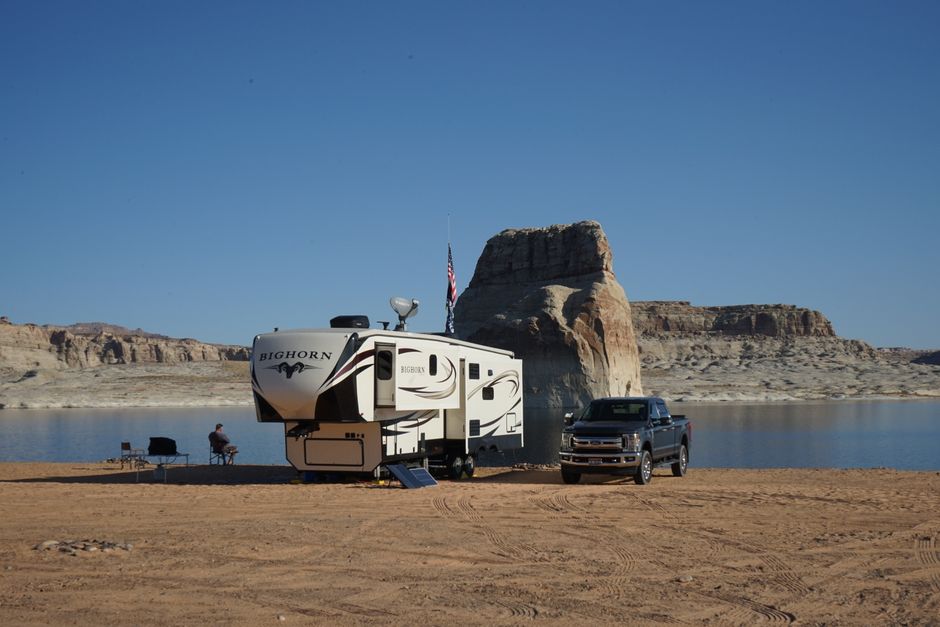
Fifth wheel with a heavy-duty truck: best balance of living space, towing stability, and the ability to detach and drive the truck independently. I’d start here if I were starting over.
Class A diesel pusher: the most comfortable daily living space, but you’re driving your house everywhere. Harder to explore tight areas.
Class C: underrated for couples, overrated for solo travelers who want space.
Van/Sprinter builds: the aesthetic is everywhere right now, and for good reason (fuel, stealth, agility), but don’t let Instagram fool you about what 70 square feet actually feels like for daily life. I know van-lifers who love it and I know people who lasted four months before renting an apartment in a panic.
Sources
- Escapees RV Club: Long-running full-timer community with mail forwarding services and residency guides; a practical resource for domicile strategy.
- RVshare Industry Report (2025): Annual survey data on full-timer demographics, costs, and lifestyle satisfaction rates.
- HealthCare.gov ACA Marketplace: Current plan pricing by state for domicile research; essential for full-timers without employer coverage.
- Campendium: User-reported nightly rates across thousands of campgrounds; more accurate than official listed rates for budgeting.
- TSD Logistics / South Dakota DMV: South Dakota’s full-timer-friendly residency and vehicle registration process, widely used in the full-timer community.
Photo: Pavel Danilyuk via Pexels