 Sandra Park
Most people watching the World Cup this summer booked a hotel six months ago and are now quietly panicking about the bill. That’s the assumption, anyway. The reality in June 2026 is stranger and more interesting: hotel occupancy across U.S. host cities is running below forecast, RV park supply has exploded, and a genuine window has opened for fans who want to actually be there without paying $400 a night for a Marriott within commuting distance of a stadium.
I’ll be honest, I didn’t expect to be writing about soccer. But when the data started coming in about what’s happening to RV park inventory and pricing near World Cup host cities right now, it was too interesting to ignore. This isn’t a travel trend piece. It’s a look at a real, time-sensitive set of conditions that won’t exist again.
The Supply Story Is Real, and the Timing Is Tight
| Host City | Average Nightly Rate | Price Range | Supply Level |
|---|---|---|---|
| Houston | $73 | $41-$223 | Highest listed parks |
| Dallas | $56-$68 | - | High |
| Kansas City | $56-$68 | - | High |
| Boston | $97-$190 | - | Standard |
| San Francisco | $97-$190 | - | Standard |
| Los Angeles | $97-$190 | - | Standard |
| Philadelphia | $97-$190 | - | Standard |
According to data from RMS and Spot2Nite cited by RV PRO, RV park supply within 50 miles of U.S. host cities more than tripled year-over-year for the June 10-20 tournament window. That’s not a rounding error. Operators clearly saw this coming and either added inventory, opened previously closed loops, or simply listed parks that hadn’t been on booking platforms before.
What surprised me was how unevenly that supply is priced. Houston, which has the most listed parks of any host city, ranges from $41 to $223 per night with an average of $73. Dallas and Kansas City are averaging $56-$68. Compare that to Boston, San Francisco, LA, and Philadelphia, where nightly rates are running $97-$190. Some of that gap is just cost of living. But some of it is operators in the southern markets who haven’t adjusted for tournament demand yet. If you’re flexible on which group stage matches you attend, Dallas and Kansas City right now represent a real arbitrage opportunity.
The hotel underperformance piece matters here too. The American Hotel & Lodging Association surveyed operators across host cities and found 80% reported bookings tracking below initial forecasts. That’s not a collapse, but it does mean the hotels didn’t hoover up all the demand the way everyone expected. RV parks are capturing some of that overflow, and more capacity is available than most fans realize.
The One-Way Rental Shift Changes Everything
The traditional problem with an RV road trip to a major event was always the same: you drive to the city, you park, you watch your game, and then you either stay put or deadhead back the way you came. Following a team through multiple host cities with a rented RV was logistically painful.
Outdoorsy addressed this directly. They launched a one-way rental program specifically designed for fans who want to follow their team between host cities, and they’ve cited unprecedented demand for RV rentals this summer tied to three major events in 2026. The one-way option means you can pick up in Dallas, catch a group stage match, drive to Kansas City for the next one, and drop the rig without a return positioning fee eating your lunch. That’s a fundamentally different calculus than what was possible even two years ago.
For people considering this right now, in mid-June, the availability question is real. Outdoorsy and similar peer-to-peer platforms will have tighter inventory as the tournament progresses. If you’re looking at Round of 16 or quarterfinal matches in late June and July, you need to be checking today, not next week.
What the Shipment Numbers Actually Tell Us
Here’s a data point that seems contradictory at first. RVIA reported that overall RV shipments in April 2026 fell 17.4% year-over-year. That sounds like a declining industry. But motorhome shipments specifically bucked that trend with a 13% increase. The towable segment dragged the overall number down.
The interpretation I keep coming back to: when people want a self-contained unit they can drive to an event, sleep in, and move the next day, they’re reaching for motorhomes, not trailers. Trailers require a tow vehicle, hookup logistics, and a reason to stay put for multiple nights. Motorhomes are hotel rooms with wheels. The World Cup use case, following matches across cities, moving every few days, parking in lots or fairgrounds near stadiums, fits the motorhome model almost perfectly. The shipment data suggests manufacturers and consumers are both reading the same signal.
The Campground Reality You Should Know Before You Book
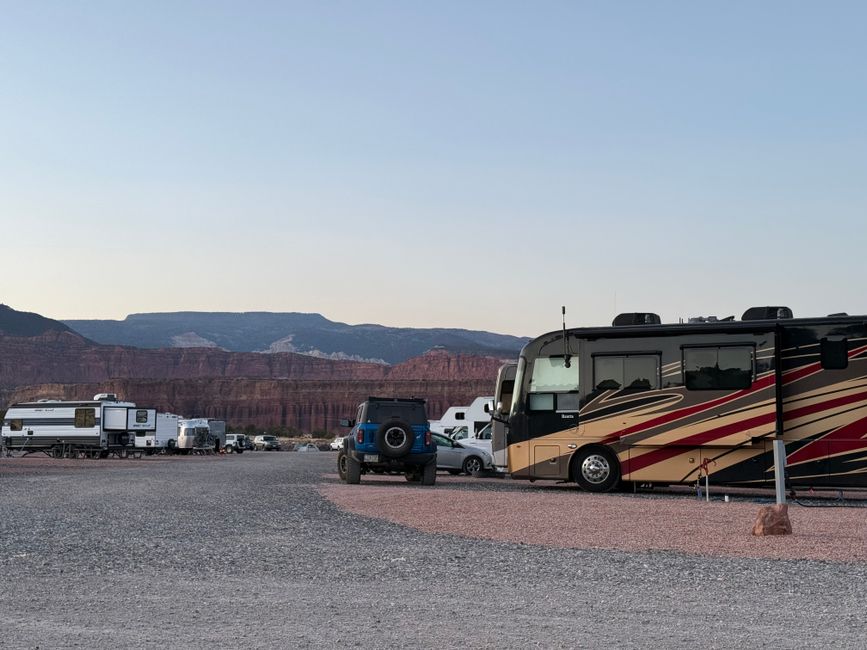
I want to be careful not to oversell this. Tripled supply doesn’t mean tripled quality. Some of what’s been listed on platforms like Spot2Nite for the tournament window is overflow parking at county fairgrounds, satellite lots on the outskirts of metro areas, and private land that’s been temporarily permitted. That’s not necessarily bad, but it’s different from a KOA with full hookups, a pool, and reliable 50-amp service.
If you’re bringing a rig that needs 50-amp power to run the AC in a Texas summer, confirm that before you book. If you’re in a Class A and need a pull-through site, don’t assume. Call the park directly. The listing platforms have gotten better, but tournament-period listings sometimes have thin detail because the operators are new to the market. I’ve stayed in plenty of places that looked fine online and were fine, and plenty that required some creative problem-solving on arrival.
Proximity to the stadium also deserves a reality check. “Within 50 miles” is the data catchment area, which means some of these parks are a serious commute from kickoff. Houston traffic on a match day is not something you want to discover 90 minutes before the whistle. Look at the actual drive time, not the mileage, and factor in that everyone else is going to the same place.
Cities Worth Prioritizing Right Now
If you’re still deciding where to focus, the value case is clearest in Houston, Dallas, and Kansas City based on current pricing and listed inventory. Houston hosting the most parks gives you the most options and the most competition keeping prices honest. Dallas and Kansas City are underpriced relative to the tournament moment, which probably won’t last into the knockout rounds.
The premium markets, Boston, San Francisco, Philadelphia, are legitimately expensive but not irrational if that’s where the matches you care about are scheduled. San Francisco in particular has limited RV-friendly infrastructure in the immediate metro area, so that range of $97-$190 reflects real scarcity. If you’re heading there, book sooner rather than later and have a backup option identified.
The honest summary is this: the conditions that make RV camping a legitimate World Cup accommodation strategy exist right now, in this tournament window, in a way they haven’t before. The supply tripled. The hotels underperformed. The rental platforms built products for exactly this use case. Whether that alignment happens again at the 2030 or 2034 tournaments is anyone’s guess. Right now it’s real, and the pricing in several markets still hasn’t caught up to the moment.
Sources
- RV Park Supply Near World Cup Host Cities More Than Triples, RVBusiness (May 19, 2026)
- FIFA World Cup 2026 Drives Surge in RV Parks Near US Stadiums, FTN News (May 19, 2026)
- How to Avoid FIFA World Cup Hotel Prices and See the Games by RV, Matador Network (November 25, 2025)
- Plan an Epic RV Road Trip for 2026 Soccer, Outdoorsy (May 5, 2026)
- Top 10 RV Industry News of June 2026, Go RV Rentals (June 2026)
- Upcoming FIFA World Cup Triples RV Park Supply Near US Host Cities, RV PRO (May 20, 2026)
Photo: KEREM TAŞER via Pexels