 Barbara Mitchell
Most people get this wrong. Not a little wrong, significantly, dangerously wrong, and it’s not entirely their fault because the RV industry has made “towing capacity” sound like a single number you look up in a brochure and compare to the weight of your trailer. It’s not. It’s the result of several interconnected calculations, and missing even one of them can put you in a situation you can’t drive your way out of.
I’ve watched people at campgrounds towing rigs that are clearly over their truck’s limits. You can see it in the way the rear of the tow vehicle squats. You can feel it when you walk past and notice the trailer tongue-to-hitch angle is way off. Eight years in, I still shake my head at how casually people skip the math on this.
Here’s what I tell people who are just getting started: your tow vehicle’s advertised maximum towing capacity is essentially the best-case number under ideal conditions with no cargo, no passengers, and no options packages eating into your payload. It’s a ceiling, not a target.
The Numbers You Actually Need (And Where to Find Them)
There are four figures that matter, and you need all of them before you can make an honest decision.
GVWR (Gross Vehicle Weight Rating) is the maximum allowable weight of your fully loaded trailer, including water, gear, and everything you’ve stuffed into the storage bays. This comes from the trailer manufacturer and is listed on a placard inside the trailer door or on the tongue.
Dry weight is what the manufacturer says the trailer weighs with nothing in it. This number is almost always a lie. Not intentionally, but they calculate it with minimum options and no water. Add a slide room, an upgraded entertainment package, upgraded batteries, extra tanks? Your real dry weight is higher. If you can, get the trailer weighed at a CAT scale before you buy it.
Payload capacity is the one people forget most often, and it’s the one that bites them hardest. This is how much weight your tow vehicle can carry in addition to its own curb weight. It includes passengers, fuel, gear in the truck bed, and the tongue weight of the trailer. You’ll find payload capacity on a yellow sticker inside the driver’s door jamb. Not in the owner’s manual, not on a website, on that sticker, for your specific truck, with your specific build.
Tongue weight is roughly 10 to 15 percent of your loaded trailer’s total weight and it counts against your truck’s payload. This trips people up constantly. They think payload is only about what’s in the bed. It’s not. The trailer hitch load goes there too.
The Calculation That Actually Matters
| Component | Example (2021 Ram 2500 6.7L Cummins) | Notes |
|---|---|---|
| Total Payload Capacity | 2,740 lbs | From door-jamb sticker |
| Passengers (2 people) | 340 lbs | Use actual body weights |
| Pets & Gear | 280 lbs | Dogs + tools/supplies |
| Pin Weight (Fifth Wheel) | 1,800 lbs | 15-25% of loaded trailer weight |
| Remaining Margin | ~320 lbs | Must be greater than zero |
| Trailer Brake Requirement | Required | Trailers over 3,500 lbs loaded |
Once you have those numbers, here’s how the math works in practice.
Start with your truck’s payload capacity from that door-jamb sticker. Subtract the weight of your passengers (use actual body weights, not some round number), subtract the weight of anything in the cab or bed, and subtract your tongue weight. What’s left has to be greater than zero. If it’s negative, you’re overloaded, full stop, regardless of what your tow rating says.
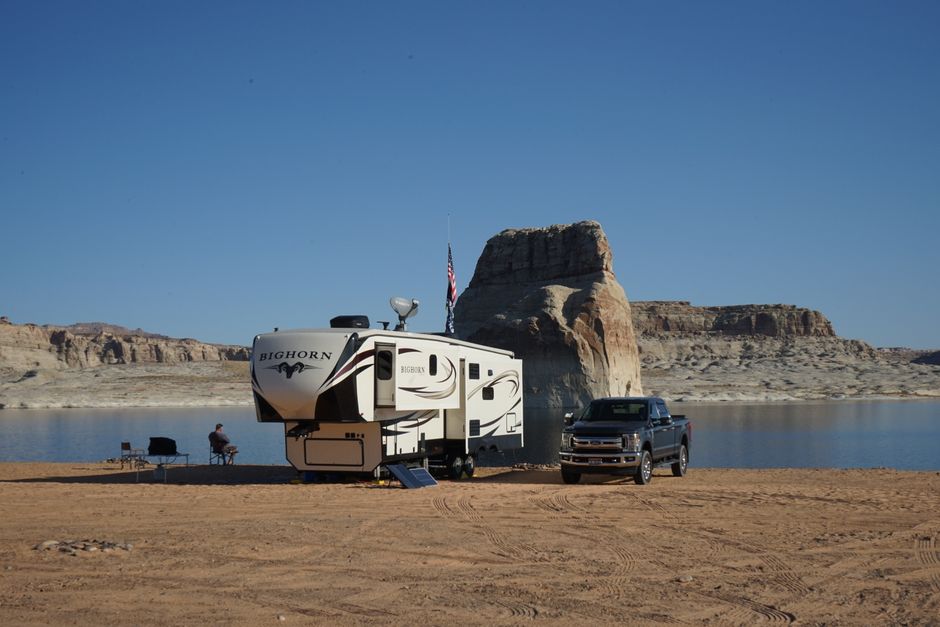
A real example: I drive a 2021 Ram 2500 with the 6.7 Cummins. The sticker on my door says 2,740 lbs of payload capacity. Sounds like a lot. But here’s how it gets eaten up: my wife and I together are about 340 lbs, our dogs add another 80, we keep maybe 200 lbs of tools and supplies in the back seat and bed. That’s 620 lbs gone before the trailer touches anything. My 28-foot fifth wheel has a loaded tongue weight around 1,800 lbs. Add it up and I have about 320 lbs of margin. That’s not a lot. One trip to Costco and two extra water containers and I’m watching that number very carefully.
For fifth wheel trailers, the “tongue weight” is called the pin weight, and it’s typically 15 to 25 percent of the loaded trailer weight, which is heavier than a bumper-pull’s tongue load. This is one reason a half-ton truck towing a fifth wheel makes me nervous regardless of what the Chevy marketing materials say.
Why the Advertised Tow Rating Is Misleading
Here’s the thing most towing articles don’t say plainly: that max tow rating in the brochure is achieved by a specific truck configuration that probably isn’t yours. It usually requires the towing package, a specific axle ratio, and an empty vehicle. Some manufacturers are more honest about this than others, but the base number is almost always aspirational.
The 2024 Ford F-150 with a 3.5 EcoBoost advertises up to 13,000 lbs of towing capacity. That’s real, under the right conditions. But that same truck with a different bed configuration, a different axle, and a fully loaded cab might have a realistic towing capacity that’s 2,000 to 3,000 lbs lower. This isn’t Ford being deceptive exactly, it’s the industry’s way of leading with the best number.
Always look for the specific tow rating for your truck’s actual configuration, which you can find in the towing guide published by the manufacturer (separate from the owner’s manual, usually a PDF on their site). Ram, Ford, and GM all publish these. They’ll have a grid showing capacity by cab style, bed length, engine, axle ratio, and whether the truck has the tow package. Use that grid.
Trailer Brakes, Weight Distribution, and the Gear You Actually Need
If your trailer weighs more than 3,500 lbs loaded, you need a trailer brake controller in the tow vehicle. Most states require it by law, and more to the point, your stopping distance with an unbraked trailer that heavy is genuinely alarming. The Redarc Tow-Pro Elite is what I use; it runs around $220 and it’s reliable. The built-in brake controllers in newer trucks are fine too.
For bumper-pull trailers, a weight distribution hitch is worth having once your trailer tongue weight exceeds about 600 lbs. A Husky Center Line TS or an Equalizer hitch redistributes that load across all axles, which brings the rear of the truck back up and keeps the front tires in meaningful contact with the road. I ran two years without one on a lighter trailer and felt the difference immediately when I put one on.
A tongue weight scale (the Sherline or a similar brand runs about $35) is one of the cheaper purchases that has genuinely saved me headaches. You load the trailer before a big trip, measure the tongue weight, and know for certain what you’re dealing with instead of estimating.
Tire pressure matters too, and it changes the effective carrying capacity of your setup. Run your tow vehicle’s rear tires at the maximum rated pressure (listed on the tire sidewall, not the door sticker) when towing. This is one of those things where the “correct” answer feels counterintuitive but it’s correct.
What Happens When You’re Over Capacity
Sources
The honest answer is: sometimes nothing. People tow over their limits and arrive safely, which is the worst possible outcome because it teaches them the wrong lesson. The problems show up in your brakes wearing faster, your transmission running hotter, your suspension wearing unevenly, and occasionally in a jackknife situation on a downgrade when you discover the combination of weight and speed exceeded the truck’s ability to manage it.
Insurance companies are also starting to look more carefully at towing situations in accidents. If you’re over your rated capacity and you have an accident, you could have a coverage problem on top of everything else. I’ve talked to two full-timers who dealt with this. It’s not hypothetical.
Get your loaded rig weighed. Most CAT scale locations (there’s a free app that maps them) charge $13 to $17 for a full axle-by-axle weigh. Do it once with a full load and you’ll know exactly where you stand. I do it every spring when I’ve made changes to my setup.
The math on this isn’t hard. It just requires you to actually do it, with your real numbers, on your real rig. That door-jamb sticker and a CAT scale visit will tell you more than any forum thread or sales pitch ever will.
Photo: Wolfgang Vrede via Pexels