 Greg Hoffman
The couple ahead of me at a Harvest Hosts winery in Oregon had been full-timing for three years in a 42-foot fifth wheel. Their rig had a washer/dryer combo, a residential refrigerator, a king-size bed, and enough storage that their teenage daughter had her own defined “zone” with a door. I was living in a 24-foot travel trailer at the time, doing laundry at coin-ops and sleeping on a mattress I could touch from both sides without moving. That conversation changed everything I thought I knew about full-time RV living. Fifth wheels, I learned that afternoon, are a different category entirely.
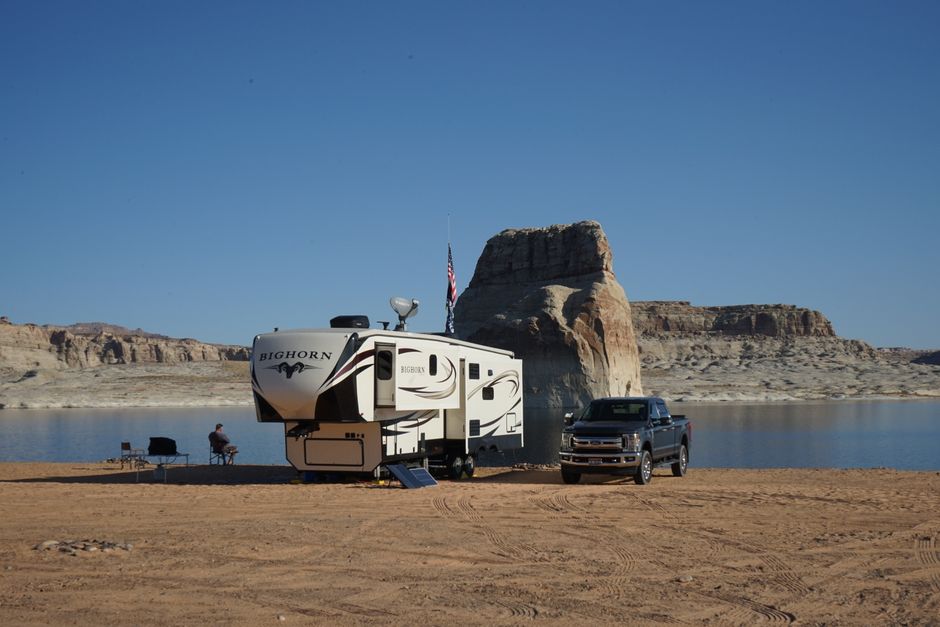
If you’re serious about living in an RV full-time, not just vacationing in one, fifth wheels deserve a long, honest look. They offer more livable space per foot, better stability while towing, and a lower center of gravity than most travel trailers. They’re not perfect. They require a pickup truck with a fifth wheel hitch installed in the bed, which costs money and limits what you can haul. They can have serious slide-room seal issues after a few years of constant use. And they’re expensive to buy and maintain. But for couples and families who plan to stay put for weeks at a time and actually want to cook real meals and work from the road, they’re often the most livable option out there.
Here’s what actually matters when you’re choosing one to live in full-time.
What Makes a Fifth Wheel Different for Full-Time Living
A vacation camper and a full-time home have almost nothing in common. When you’re camping for a long weekend, you can tolerate a tight galley kitchen, a dinette that converts to a bed, and a bathroom the size of a phone booth. When that’s your actual house, those compromises compound fast.
The bi-level floor plan is the big one. The front section sits over the truck bed and becomes a dedicated bedroom, and it changes everything. You get real separation of spaces. The bedroom isn’t just a bed at one end of a long tube. It’s upstairs, it’s quieter, and it doesn’t turn into a living room during the day. That single feature makes a 36-foot fifth wheel feel significantly larger than a 36-foot travel trailer.
Storage is the other major advantage. Fifth wheels typically have more basement storage, more overhead cabinets, and better-organized utility spaces. I’ve been inside full-time fifth wheels where people kept tools, a folding bike, a generator, and full seasonal wardrobes in the basement compartments alone. That’s not possible in most travel trailers or class A motorhomes at the same price point.
The stability while parked is better too. Because the hitch point is over the rear axle of the truck, there’s less pitch and sway when you’re moving around inside. You’re not rocking the whole rig every time you get up at 2 a.m.
The Fifth Wheels That Actually Hold Up to Full-Time Use
Not every fifth wheel is built for full-time living. Some are weekend rigs dressed up with residential features. Knowing the difference before you buy saves you from a very expensive mistake.
Grand Design Reflection and Solitude series are consistently at the top of the list for good reason. Grand Design has a reputation for better-than-average construction quality and responsive customer service. The Solitude in particular is marketed directly at full-timers, with a four-point auto-leveling system, residential-style kitchen, larger holding tanks (the 380FL has a 100-gallon fresh water tank), and insulation rated for four-season use. New prices commonly run $70,000 to $100,000, but the build quality shows.
Keystone Montana is the best-selling fifth wheel in the country and has been for years. That dominance cuts both ways. Parts are widely available, dealer networks are large, and there’s a massive owner community online to help you troubleshoot anything. But Keystone’s quality control has been inconsistent. Some Montana owners have zero problems for years. Others have had serious delamination, slide room issues, and electrical gremlins from day one. If you’re considering a Montana, have it inspected thoroughly before you sign anything, and join the Montana Owners Club forum before you start shopping. That community will tell you exactly which floor plans and model years to avoid.
Luxe Elite and Gold fifth wheels are built in Indiana by a smaller manufacturer genuinely aimed at full-timers who want near-custom quality without going fully custom. Aluminum framing instead of wood, lifetime structural warranty, and construction tolerances that hold up better over years of movement. Expect $120,000 to $160,000 for a new unit. But depreciation is slower and the resale market is strong because demand outpaces supply.
Tiffin Allegro Bay and DRV Mobile Suites round out the premium end. DRV in particular is the closest thing to a factory-built permanent home in the fifth wheel world. Triple-slide floor plans, residential appliances, tile floors, and solid wood cabinetry are standard. If you’re retiring into a fifth wheel and plan to stay in one spot for months at a time, DRV deserves serious consideration.
Side-by-Side Comparison: Four Popular Full-Time Fifth Wheels
RV LIVING FOR BEGINNERS - The RV Basics You Should Know! · HappilyEverHanks on YouTube
| Model | Approx. New Price | Fresh Tank | Four-Season Rated | Frame Type | Best For |
|---|---|---|---|---|---|
| Grand Design Solitude 380FL | $85,000-$105,000 | 100 gal | Yes | Wood/aluminum composite | Couples, small families |
| Keystone Montana 3855BR | $65,000-$80,000 | 60 gal | Partial (Climate Package) | Wood | Budget-conscious full-timers |
| Luxe Elite 44MB | $130,000-$160,000 | 100 gal | Yes | Full aluminum | Long-term full-timers, retirees |
| DRV Mobile Suites 44Memphis | $150,000-$175,000 | 100 gal | Yes | Steel/aluminum hybrid | Stationary or slow-travel full-timers |
| Model | Approx. New Price | Fresh Tank | Four-Season Rated | Frame Type | Best For |
|---|---|---|---|---|---|
| Grand Design Solitude 380FL | $85,000-$105,000 | 100 gal | Yes | Wood/aluminum composite | Couples, small families |
| Keystone Montana 3855BR | $65,000-$80,000 | 60 gal | Partial (Climate Package) | Wood | Budget-conscious full-timers |
| Luxe Elite 44MB | $130,000-$160,000 | 100 gal | Yes | Full aluminum | Long-term full-timers, retirees |
| DRV Mobile Suites 44Memphis | $150,000-$175,000 | 100 gal | Yes | Steel/aluminum hybrid | Stationary or slow-travel full-timers |
These prices shift constantly. A two-year-old Grand Design Solitude in good condition can be found for $55,000 to $65,000 if you’re patient and willing to travel to pick it up.
The Truck Question Nobody Wants to Talk About
You can buy the perfect fifth wheel and ruin the whole experience by underestimating the truck requirement. This is where I’ve watched otherwise smart, well-researched people make catastrophic mistakes.
A loaded 40-foot fifth wheel with full tanks and gear can easily hit 18,000 to 20,000 pounds of Gross Vehicle Weight. You need a truck rated to handle that. A half-ton pickup like the Ford F-150, Ram 1500, or Chevy Silverado 1500 is not adequate for most full-size fifth wheels. You need a three-quarter ton minimum (F-250, Ram 2500, Silverado 2500), and for anything over 16,000 pounds, a one-ton dually (F-350, Ram 3500, Silverado 3500) is the safer, saner choice.
The hitch itself matters too. A B&W Companion or Reese Elite hitch runs $800 to $1,500 installed. Don’t cheap out here. The hitch lives in your truck bed permanently, which limits cargo capacity, so factor that into your planning.
Diesel vs. gas is a real debate. Diesel trucks get significantly better mileage while towing (I typically saw 10-13 MPG towing heavy versus 7-9 MPG with a comparable gas engine). Diesel maintenance is more expensive and you can’t find a diesel mechanic at every small-town shop. Gas engines are simpler and cheaper to maintain, but you’ll feel the fuel costs on long hauls.
Making a Fifth Wheel Actually Livable Full-Time: Practical Upgrades
Sources
- battery monitor like the Victron BMV-712
- Progressive Industries EMS-HW50C hardwired surge protector
- Camco TastePURE water filter
- Lynx Leveling blocks
- Mo Eid
The rig that comes off the dealer lot is a starting point, not a finished home. Every serious full-timer I know has made significant modifications in the first year. Here are the ones that matter most.
Power management. Shore power isn’t always available, and generators are loud and expensive to run constantly. A solar and lithium battery system is the single most impactful upgrade for full-time living flexibility. A 400-watt to 800-watt solar array paired with 200 to 400 amp-hours of lithium (LiFePO4) batteries gives you several days of independent living. A battery monitor like the Victron BMV-712 (affiliate link, we may earn a commission) tells you exactly what’s going in and coming out so you’re never guessing.
Surge protection. Campground power is dirty. Voltage spikes and low-voltage conditions destroy inverters, refrigerators, and air conditioner compressors. A Progressive Industries EMS-HW50C hardwired surge protector (affiliate link) is a $300 investment that has saved full-timers from $3,000 repair bills more times than I can count.
Water filtration. City water hookups vary wildly in quality. A good inline filter removes sediment, chlorine, and other contaminants before they hit your fresh tank or plumbing. The Camco TastePURE water filter (affiliate link) is inexpensive and widely trusted. For longer stays, a countertop reverse osmosis system makes a real difference in water quality.
Leveling. Even with an auto-leveling system, having a set of Lynx Leveling blocks (affiliate link) on hand gets you through situations where the auto-levelers don’t have enough range. Uneven sites are everywhere outside of premium resorts.
Cellular connectivity. This is your internet, your work connection, and your entertainment. A dedicated cellular router with an external antenna, like the Pepwave MAX BR1 or the Starlink RV option, is worth more than almost any other upgrade if you work remotely.
Six years and 90,000 miles have taught me that the rig is maybe 40 percent of the equation. The rest is how you handle the inevitable breakdowns, the campsite that floods at midnight, the propane that runs out in January, and the 200-mile detour you didn’t plan. A well-built fifth wheel gives you the foundation. It won’t make the hard days disappear, but waking up in a space that genuinely feels like home, wherever you parked it the night before, makes a real difference on the long haul.
Photo: Mo Eid via Pexels