 Sandra Park
The number that stopped me cold when I first started researching full-time RV living was $1,800 a month. I’d seen it everywhere online, this tidy figure that made living on the road sound almost affordable. Then I actually did it, and year one cost me closer to $3,400 a month. Not because I was careless or living lavishly. Because the $1,800 number leaves out half the real expenses.
Eight years later, I can tell you what it actually costs, why the range is so wide, and where people get blindsided. I’ve seen couples live genuinely well on $2,200 a month and I’ve seen solo travelers blow $5,000 without much to show for it. The difference usually isn’t lifestyle choices. It’s whether they planned for the real categories or just the obvious ones.
The Big Four: Where Most of Your Money Goes
| Expense Category | Monthly Range | Notes |
|---|---|---|
| Campgrounds | $400-$900 | Mix of boondocking, state parks, and full-hookup sites |
| Fuel | $200-$900+ | Depends on travel frequency; $1/mile for typical diesel Class A |
| Food | $400-$700 | Per person; varies with eating out habits |
| Health Insurance | $350-$600 | ACA marketplace for relatively healthy 40-year-old |
| RV Insurance | $100-$200 | Monthly equivalent of $1,200-$2,400 annually |
| RV Maintenance | $50-$100 | Average monthly (1-2% of RV purchase price annually) |
| Storage Unit | $80-$150 | Typical 5×10 unit in most markets |
| Estimated Total | $1,380-$2,950+ | Before domicile, mail forwarding, and vehicle-specific costs |
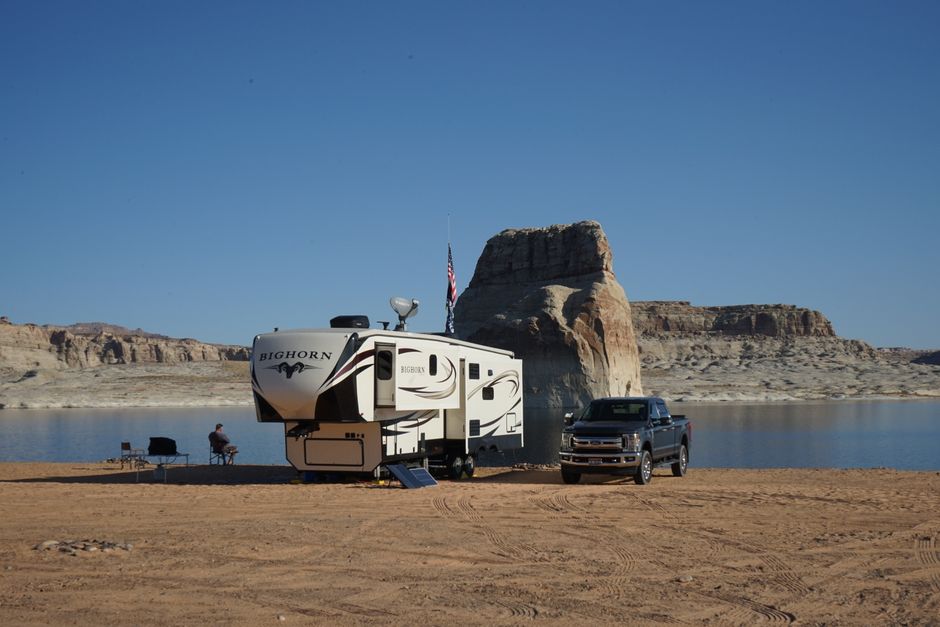
Campground fees are usually the biggest single line item, and they vary more than almost anything else in this life. A full hookup site at an RV resort near a major city or popular destination can run $60 to $90 per night. Do the math: that’s $1,800 to $2,700 a month if you’re staying in places like that. Most full-timers don’t, but if you’re new to this and still figuring out your routes, you’ll pay that rate more than you expect.
The people who keep campground costs down do it through a combination of strategies. State and national forest dispersed camping (free, but you need to move every 14 days and you won’t always have hookups). Corps of Engineers campgrounds, which often run $18 to $26 a night with electric. Thousand Trails or Harvest Hosts memberships, which cost a few hundred dollars upfront but pay for themselves quickly. Seasonality matters too. That same Florida campground that charges $75 a night in January charges $35 in August, because it’s August in Florida.
Realistically, if you’re a mix of boondocking, state parks, and occasional full-hookup sites, you’re probably looking at $400 to $900 a month on campgrounds. That’s my actual range over the years.
Fuel is the second big one, and it’s the most variable because it depends entirely on how much you move. I’ve had months where I drove 2,000 miles and months where I drove 200. A diesel Class A getting 8 mpg at $4 per gallon costs you $1 per mile in fuel alone. If you move every week, that adds up fast. The full-timers I know who keep fuel costs under $200 a month are mostly the slow travelers: people who pick a region, stay two to four weeks per spot, and don’t chase weather across three time zones. The ones who drive 1,500 miles a month are paying $600 to $900 in fuel, sometimes more.
Food runs roughly what it runs anywhere, maybe slightly more if you’re eating out a lot because you’re in tourist areas, slightly less if you’re good at cooking in a small kitchen. Figure $400 to $700 a month per person. I spend about $500 a month now, cooking most meals, occasionally splurging on local restaurants because that’s half the point of being somewhere new.
Health insurance is the one that surprises people most, especially if they’re coming from employer-sponsored coverage. Without a group plan, you’re shopping the ACA marketplace or a health share ministry or going without, and none of those options are simple or cheap. A relatively healthy 40-year-old looking at a mid-tier ACA plan is probably paying $350 to $600 a month, depending on your state of domicile, your income, and the subsidy you qualify for. Some full-timers manage this well by keeping income below certain thresholds to maximize subsidies. Others pay full freight. Either way, you need to budget for it.
The Vehicle Itself: What They Leave Out of the Calculators
Your RV payment and insurance together are often treated as fixed costs, which they are. But what gets omitted is maintenance and repair, which is not fixed and is also enormous.
I’ve talked to too many people who budgeted $200 a month for “RV maintenance” based on what they read online. Then the slides stopped working, or the water heater corroded through, or the roof seams needed resealing, and they were looking at a $1,500 to $4,000 repair they hadn’t planned for. The rule I use, and the one I’ve heard from every experienced full-timer I respect: budget 1% to 2% of your RV’s purchase price per year in maintenance costs. On a $60,000 RV, that’s $600 to $1,200 a year, or $50 to $100 a month on average. But it doesn’t come in smooth monthly increments. It comes as a $3,500 transmission repair in April when you’re in the middle of nowhere in New Mexico.
What most people don’t realize is that the age and type of your rig matters more than almost anything else in determining repair costs. A Class C under five years old with low miles is going to be much cheaper to maintain than a 15-year-old Class A diesel pusher, regardless of how good a deal the latter was. I’ve watched people buy a $40,000 older diesel and spend $12,000 in repairs in their first two years. That “affordable” rig ended up costing more than a newer one would have.
RV insurance typically runs $1,200 to $2,400 a year for full-timers, because full-time policies are categorized more like homeowners insurance than vehicle insurance. If you have a loan, you’re also carrying collision and comprehensive, which bumps the number up. I pay about $1,700 a year for my current setup.
A tow vehicle or toad (if you have a motorhome and want to tow a car) adds another layer: fuel, insurance, registration, and maintenance on a second vehicle. Easy to overlook when you’re in the dreaming phase.
The Costs Nobody Puts in Their YouTube Budget Videos
7 Things We Wish We Knew BEFORE Starting RV Life FULL-TIME (1 month on the road) · Lloyd & Mandy on YouTube
Storage. Even if you’re living out of your RV, most full-timers have some belongings in a storage unit. Even a 5x10 runs $80 to $150 a month in most markets today.
Mail and domicile. You need a legal address, and most full-timers use a mail forwarding service and choose a low-tax state as their domicile. South Dakota, Texas, and Florida are the popular choices. Good mail forwarding services like Escapees or America’s Mailbox run about $20 to $30 a month, plus forwarding costs when you need physical mail sent to you.
Cell service and internet. This is non-negotiable if you’re working remotely or even just want reliable communication. Most serious full-timers run two carriers for redundancy. I pay about $230 a month total between a Verizon unlimited plan and a T-Mobile hotspot line. Some people add Starlink for rural coverage, which currently runs $120 a month for the RV plan after the initial hardware cost.
Propane. Often overlooked. You’ll use it for your furnace, cooktop, and water heater. In winter, heavy furnace use can mean refilling a 30-pound tank every week or two in colder climates. Budget $30 to $80 a month depending on season and region.
And then there’s what I call the “because you’re a tourist” effect. When you’re in a new place, you go do the things. You take the kayak tour, you eat at the local spot, you buy the thing at the craft fair. It’s actually one of the best parts of this life, but it doesn’t show up in the basic budget. I budget $150 to $300 a month specifically for this, and I don’t apologize for it.
So What Does It Actually Add Up To?
Here’s a realistic range based on real spending patterns I’ve seen and tracked personally:
Lean but comfortable: Around $2,000 to $2,500 a month. This usually means boondocking heavily, cooking almost every meal, low-debt rig, minimal movement, no Starlink. Very doable. Requires planning and flexibility.
Moderate and sustainable: $2,800 to $3,800 a month. Mix of free camping and paid sites, working remotely with good internet, moving every few weeks, newer rig with manageable payments. This is where most full-timers I know actually land after a year or two of figuring it out.
Comfortable and mobile: $4,000 to $5,500 a month. Frequent campground stays with full hookups, eating out regularly, newer or higher-end rig, all the tech, moving often. Not extravagant by any measure, but not budget RVing either.
The single biggest lever is how much you move and what you drive. After that, it’s campground choices. Everything else you can optimize at the margins, but those two decisions set the floor and ceiling more than anything.
The math works. For a lot of people it works really well. But go in knowing the real numbers, not the optimistic YouTube version. Your future self, standing in a campground in Montana watching the sun hit the Rockies, will appreciate having planned for that surprise alternator replacement without it ruining the month.
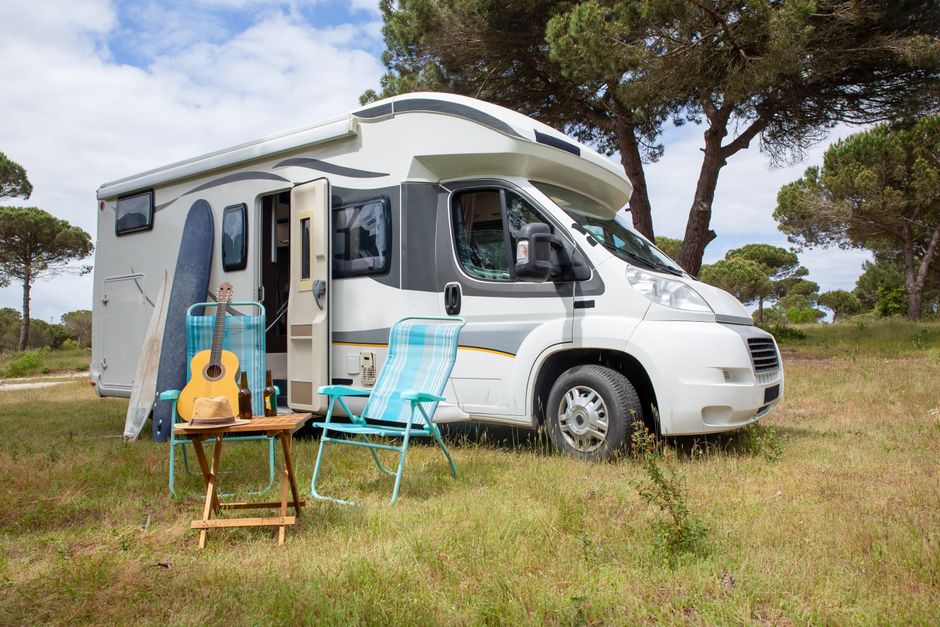
Photo: Tom Fisk via Pexels
Sources
- Tom Fisk
- Renogy 200W Solar Starter Kit + 30A Charge Controller
- Renogy 2×100W Monocrystalline Solar Panels
Disclosure: As an Amazon Associate, we earn a small commission from qualifying purchases at no extra cost to you. We only recommend products that genuinely support the topics covered in this article.
- Renogy 200W Solar Starter Kit + 30A Charge Controller (~$169), Complete beginner solar kit, 200W monocrystalline panel, charge controller, and mounting hardware included.
- Renogy 2×100W Monocrystalline Solar Panels (~$99), Expandable 200W panel set from the most trusted DIY solar brand, used widely in off-grid and home backup systems.